
 Texas 67 SystemsCall for Consultation 469-907-5567
Texas 67 Systems insights
Why WordPress Still Matters for Small Business Websites
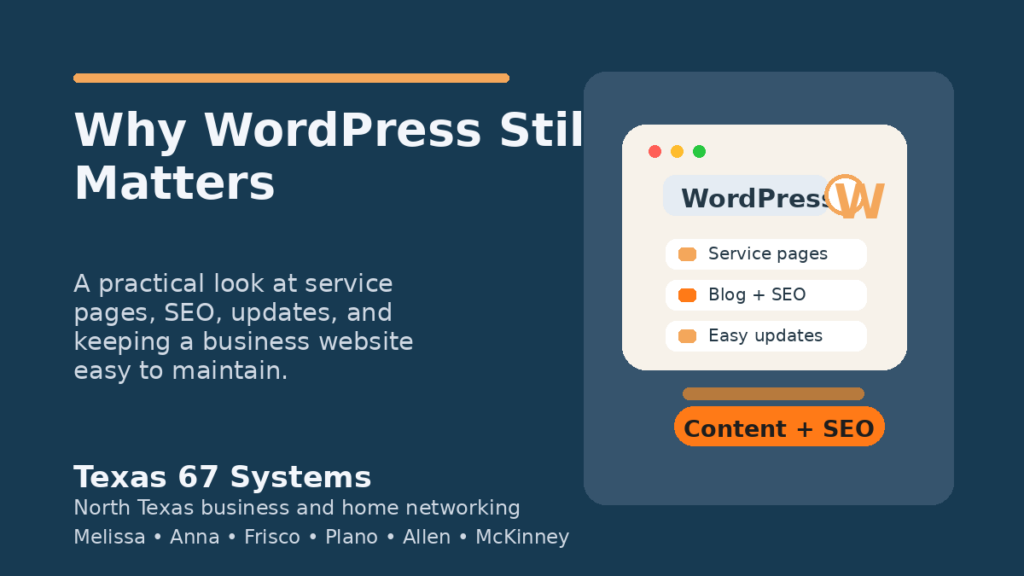
WordPress still matters when a small business needs a website that can be updated, improved, and tied to real sales and service operations.
A lot of business owners are tired of hearing about websites.
That makes sense. Most of the time, the conversation gets reduced to design trends, platform debates, or sales talk about a "modern online presence."
But for a small business, the website is usually much simpler than that.
It is where people go when they are deciding whether to call you.
They check what you do, where you work, whether the business looks current, whether the phone number is easy to find, whether the service pages make sense, and whether the company feels real. If the site is confusing, outdated, slow, or hard to trust, a lot of those people leave before they ever contact anyone.
That is why WordPress still matters.
For Texas 67 Systems, WordPress is not just "the website platform." It is part of the sales and operations layer. It is where service pages live, where blog content supports search visibility, where trust gets built or lost, and where a business either gains control over its messaging or keeps fighting its own site.
What WordPress is in plain language
In plain language, WordPress is a content management system. That means it gives a business a structured way to run a website without hand editing every page from scratch.
Pages, blog posts, images, menus, categories, tags, forms, and SEO fields all have a place to live. A business can update content, add new pages, publish articles, and keep the site moving without rebuilding the whole thing every time something changes.
That sounds basic, but it matters.
A small business website is rarely finished. Services change. Pricing language changes. Hours change. New photos get added. Old team members leave. New locations open. A landing page needs a better CTA. A service area page needs cleaner copy. A blog post needs internal links after a new service page goes live.
If the website cannot handle that kind of steady operational work, it starts falling behind fast.
Why WordPress still matters
There are plenty of website platforms now. Some are easier in certain situations. Some are cleaner for very small brochure sites. Some are great if the business fits their template and never needs much flexibility.
WordPress still matters because a lot of small businesses need a middle ground.
They need a site that can:
- grow over time
- support service pages and blog content
- handle SEO basics cleanly
- support forms and lead capture
- allow content changes without starting over
- work with a broader support and maintenance process
That is the real value.
WordPress is not interesting because it is trendy. It matters because it gives a business room to operate.
For Texas 67 Systems, that matters a lot. The website is not separate from the rest of the business stack. It connects to content planning, SEO work, service positioning, analytics, support, and lead flow.
That same operating mindset shows up across the rest of this series too. It is the same reason posts like Why Texas 67 Systems Runs on Docker and Open Source, Why Gitea Matters for Texas 67 Systems, Why Rybbit Analytics Matters for Texas 67 Systems, and Why Synapse Matters for Texas 67 Systems matter.
Different tools. Same basic idea. Own the system, document it, and make it easier to maintain.
The business problems WordPress solves when it is set up well
A good WordPress site solves more than one problem at once.
1. It gives the business a real content home
A lot of companies rely too heavily on social platforms, directory listings, or paid traffic. Those channels can help, but they are not the main home of the business.
Your website is where your service pages, case-study style content, FAQs, contact paths, and trust signals can all live in one place.
That matters for local service companies. A business owner looking for network installation, managed IT support, website help, or SEO support usually wants to see more than a logo and a phone number. They want enough context to decide whether the company looks credible.
2. It supports search visibility in a practical way
SEO gets oversold all the time, but the basic version is still true: if the website clearly explains what you do, where you do it, and how to contact you, it has a better chance of showing up for the right searches.
WordPress helps because it supports service pages, blog content, internal links, headings, images, metadata, and structured publishing habits. That does not guarantee rankings. It does make the site easier to improve over time.
That is a big reason Texas 67 Systems ties website work to ongoing content and SEO Services instead of treating the site like a one-time design project.
3. It makes updates more realistic
A website usually gets worse when content updates are hard.
If it takes too much effort to fix a service description, update a CTA, replace old photos, publish a useful article, or improve a form, those updates get postponed. Then the site slowly stops matching the actual business.
WordPress is useful because it lowers the friction of those routine changes when the site is built sanely.
4. It gives marketing and operations a place to meet
This is one of the more important points.
A website is not just a marketing object. It is also an operating surface.
Forms have to route correctly. Pages have to load. Links have to work. Tracking has to be accurate. Content has to stay current. Admins have to be managed. Backups have to exist. Updates have to be tested.
That is why WordPress belongs in the same conversation as support and maintenance, not just branding.
Where WordPress goes wrong
WordPress can be very good. It can also become a mess.
Most WordPress problems are not really WordPress problems. They are maintenance problems, process problems, or "too many people touched this without a plan" problems.
A few common failure points show up over and over:
Plugin sprawl
This is a big one.
A site starts with a few plugins. Then a form plugin gets added. Then an SEO plugin. Then a popup plugin. Then a slider plugin. Then a performance plugin. Then another plugin to fix what the first plugin broke.
A year later, nobody is fully sure what is still needed.
That creates risk, slows the site down, and makes updates more stressful than they should be.
Hard-to-edit page builders
Some WordPress builds look fine on the front end but are frustrating to maintain on the back end. Every small text edit turns into a scavenger hunt. Layout blocks do not behave predictably. Reusable sections are not actually reusable. Mobile cleanup gets skipped because nobody wants to fight the editor.
That is not a good long-term setup.
Weak update discipline
A site can sit untouched for too long because nobody wants to break anything.
Then eventually the business needs an urgent update, and now the gap between current reality and site reality is bigger than it should be. Core, theme, plugin, and form behavior all become more fragile when updates are ignored until they turn into a problem.
Content drift
This one hurts more than people think.
The company changes, but the website does not. Services expand. Old wording stays live. Staff changes. Coverage areas shift. A page still talks like it is two years ago. That disconnect costs trust.
Pretty is easy. Useful takes more work.
How Texas 67 Systems uses WordPress in the real world
For Texas 67 Systems, WordPress matters because the website has a job to do.
It needs to explain services clearly. It needs to support local search. It needs to give people a clean path to call, text, or reach out. It needs to hold blog content that is actually tied to real services instead of generic filler.
It also needs to fit into a larger operating stack.
Content planning does not happen in isolation. Analytics are not separate from page edits. SEO is not separate from service-page clarity. And publishing is not separate from maintenance.
That is why WordPress fits best when it is treated like part of a system.
For example:
- blog posts support service visibility
- service pages support buyer intent
- analytics help show which pages earn attention and which ones leak it
- maintenance keeps forms, plugins, and page behavior from quietly degrading
- documentation and version-aware workflows make changes safer
That is the difference between "having a website" and actually running one.
This is also why WordPress pairs naturally with services like Website Design and Development and Business IT Managed Services. Website problems are often part content, part UX, part maintenance, and part operational discipline.
Why WordPress still fits the Texas 67 model
Texas 67 Systems tends to prefer systems that are understandable, maintainable, and flexible enough to evolve. WordPress still fits that model when it is built cleanly and supported with discipline.
That does not mean every WordPress site is good.
It means WordPress remains a practical choice when the business needs:
- control over its own content
- room to expand service pages and articles
- stable local SEO foundations
- flexible updates without rebuilding everything
- a supportable maintenance path
That is a better reason to choose a platform than hype.
When WordPress is the right fit and when it is not
WordPress is usually a good fit when:
- the business needs ongoing content updates
- service pages matter for local search and conversions
- multiple people may need to edit or review content over time
- the company wants room to grow without changing platforms every year
- there is a real plan for maintenance, backups, and updates
It may not be the best fit when:
- the site is extremely small and unlikely to change much
- the business wants the simplest possible builder with very few moving parts
- nobody is going to maintain the site at all
- the current problem is weak messaging or weak offer clarity, not the platform itself
That last point matters.
Sometimes people blame WordPress when the real issue is bad copy, weak service structure, cluttered layout, or no real maintenance process. Changing platforms will not fix that by itself.
FAQ
Is WordPress still a good choice for a small business website?
Yes, often. It is still a solid choice when the business needs editable service pages, blog content, SEO control, and room to grow over time.
Does WordPress automatically make a site rank better?
No. WordPress can make SEO work easier to manage, but rankings still depend on the quality of the pages, the clarity of the service offering, site performance, internal linking, and the overall usefulness of the content.
What usually causes WordPress sites to become hard to manage?
Too many plugins, weak update habits, messy page-builder setups, poor documentation, and years of small changes without a clear structure.
Is WordPress only for blogging?
No. It can run full business websites, service pages, landing pages, resource content, and blog content. The blog is just one piece of the larger site.
What if the site looks fine but still is not helping the business much?
Then the issue may be messaging, speed, CTA clarity, forms, local SEO alignment, or page structure. A site can look decent and still underperform.
Final thought
WordPress still matters for Texas 67 Systems because websites still matter, and most small businesses need more than a static online brochure.
They need a site they can update, trust, improve, and tie into the rest of the business.
When WordPress is set up well, it gives that business a practical home for content, service visibility, and lead flow. When it is neglected, it becomes one more thing the owner avoids touching.
If your site is hard to update, slow to load, weak on conversions, or buried under too many plugins and too little process, Texas 67 Systems can help clean it up and make it easier to maintain.
Call 469-907-5567 or text 214-310-5445, explore Website Design and Development, review SEO Services, or use the Contact page to start the conversation.
Next step
Ready to figure out the next step?
Send the details you have. We will help turn the problem into a practical plan.